
- CREA
- FR
- Publications
- Collection Études d'archéologie
-
Partager cette page
The Early Iron Age Necropoleis at Marathon (Attica) | Burial Sites, Funerary Practices, Pottery Production and Uses
Auteure
Vicky Vlachou
ANNÉE
2026
ISBN
978-2-9603778-4-2
LIEU
Bruxelles
EDITION
CReA-Patrimoine
COLLECTION
Études d’archéologie 26
PAGES
443
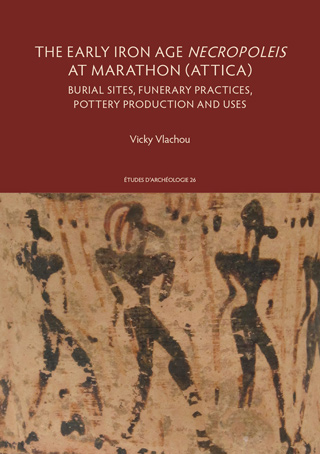
This volume offers a synthetic account of the archaeological evidence from pre-Classical Marathon, spanning the eleventh to the early seventh centuries BC. It foregrounds funerary contexts as a principal source for reconstructing mortuary practice, craft production, and the spatial organisation of burial grounds and adjacent habitations. The study examines three discrete zones within the classical demes boundaries: Oinoe and Skaleza along the road traversing the Oinoe ravine, the Marathon plain from coastal Plasi to the modern Vrana, Valaria and Brexiza on the south-eastern slopes of Mount Agrieliki. The study of seventy-one burials and few more funerary assemblages and deposits cover more than a century of archaeological investigation at Marathon. Pottery constitutes the largest and most diagnostic category of material culture. Stylistic sequences from the Submycenaean and Early Protogeometric through the Middle Protoattic phases reveal both local developments and sustained connections with wider Attic production centres. Analysis of pottery permits renewed consideration of craft mobility, the transmission of technical practices, and interregional linkages that include Athens and neighbouring Attic districts. Comparative treatment of the Marathonian necropoleis alongside contemporaneous burial spaces in east and south-east Attica contributes to a broader understanding of site growth in the early first millennium BC. The evidence indicates that concerns over land sustainability, lineage and kinship were central to locally established oikoi and that these preoccupations are materially articulated in the funerary record in ways comparable to those documented for contemporary Athenian elites. By contrast, the archaeological record offers only tenuous support for an early formation of the Marathonian Tetrapolis, rendering its establishment before the late sixth century BC problematic.
https://difusion.ulb.ac.be/